When you walk into a kitchen showroom, it's easy to focus on beautiful paint colors, striking hardware, and trendy glass-front doors. But a kitchen cabinet is ultimately a structural workhorse — a single cabinet door will be opened and closed thousands of times over its lifetime, supporting heavy stacks of stoneware, cast iron skillets, and modern culinary appliances.
If you are planning a long-term kitchen investment along the Front Range, you need to look past the finish and ask: What are the signs of high-quality cabinet construction?
In the semi-arid, high-altitude climate of Northern Colorado, indoor humidity levels fluctuate dramatically between dry winters and summer storm seasons. These environmental changes place real physical stress on wood cabinetry. Poorly constructed cabinets can lead to structural sagging, warping, and failing hardware within just a few years.
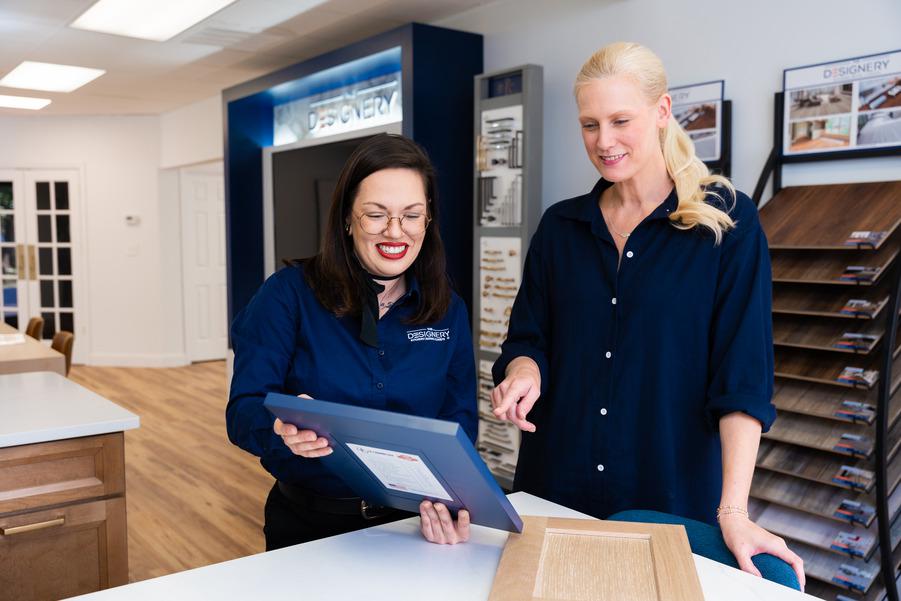
At The Designery Longmont, located on Ken Pratt Blvd, we help homeowners understand what happens behind the cabinet door. Here is a guide to the construction details that separate premium, long-lasting cabinetry from low-cost, short-lived alternatives.
Why Does All-Plywood Cabinet Construction Matter for Kitchen Durability?
The structural foundation of any cabinet is the cabinet box itself. Most residential cabinetry boxes are built using one of two primary core materials: all-plywood or particleboard (often labeled as furniture board or medium-density fiberboard).
The Physical Superiority of Plywood
Plywood is constructed by gluing together alternating, cross-laminated layers of solid wood veneer. This cross-grain configuration gives plywood extraordinary mechanical strength and dimensional stability.
Weight and Load Bearing: Plywood holds heavy loads over long spans without sagging — making it ideal for upper cabinets carrying heavy dishware or base cabinets supporting quartz or granite countertops.
Fastener Retention: Screws bite directly into cross-laminated layers of real wood, giving plywood superior fastener retention. Over time, heavy cabinet doors or high-use pull-out pantry shelves will not pull away from a plywood frame.
The Problem with Particleboard in High-Moisture Zones
Particleboard is manufactured by binding wood chips, sawdust, and synthetic resins together under intense heat and pressure. While high-density particleboard provides a flat surface for laminates, it behaves poorly when exposed to moisture or physical impact.
If a plumbing joint drips beneath a kitchen sink or a dishwasher vents steam near a particleboard cabinet base, the unprotected wood fibers absorb the moisture — causing the material to swell, flake apart, and structurally fail. For long-term durability in a busy kitchen, all-plywood box construction remains the gold standard.
What Is the Difference Between Soft-Close Dovetail Drawers and Standard Cabinetry Joints?
A cabinet drawer box experiences more direct kinetic energy and physical stress than almost any other component in your kitchen. How the corners of those drawer boxes are joined reflects the overall quality of the manufacturing.
The Strength of Dovetail Joints
Premium cabinetry features dovetail drawer boxes. A dovetail joint uses interlocking, wedge-shaped wooden teeth — tails and pins — to secure the front, sides, and back panels of the drawer box.
The shape of a dovetail joint creates a permanent mechanical lock. When you pull open a heavy drawer loaded with pots and pans, the physical force is absorbed by the interlocking wood teeth rather than relying solely on glue or hardware fasteners.
High-quality dovetail drawers are paired with heavy-duty, soft-close, under-mount drawer glides. These glides are hidden completely beneath the drawer box, protecting them from dust and kitchen debris while providing smooth, quiet closing action.
The Limits of Standard Dado and Stapled Joints
In low-cost cabinetry, drawer boxes are often assembled using standard butt joints or shallow dado grooves secured with industrial staples, thin nails, and wood glue. These joints lack any mechanical interlocking strength. Over years of daily use, the repeated pulling force places direct stress on the staples and glue — and eventually, the drawer front can pull away from the side panels entirely.
Standard drawers also frequently use visible, side-mounted roller tracks. These reduce the usable width of your drawer interior, expose mechanical components to grease and food crumbs, and lack the smooth deceleration of soft-close systems.
How Do Supply Chain Partnerships Affect Cabinet Pricing?
When shopping for top-tier construction elements — all-plywood frames, soft-close dovetail drawers, premium factory-cured finishes — it's worth asking any design firm how they source their cabinetry.
In a traditional model, a local showroom purchases through multi-tiered regional distributors. Each step in that chain adds operational markup, shipping fees, and inventory costs. A firm with direct manufacturer relationships and volume purchasing power can bypass those markups, making premium cabinet lines more accessible at mid-range budget levels.
At The Designery Longmont, our integration with a national supply network allows us to source cabinetry with top-tier structural specifications — solid wood face frames, dadoed joint reinforcements, and multi-step baked factory finishes — at price points that fit realistic remodeling budgets.
Frequently Asked Questions
What is a full-overlay cabinet door style, and how does it affect quality?
A full-overlay door style means the cabinet doors and drawer fronts are sized to sit closely together, covering almost the entire face frame of the cabinet box. While overlay style is primarily an aesthetic preference — offering a clean, modern look compared to partial-overlay doors — full-overlay configurations require highly accurate manufacturing tolerances and heavy-duty, six-way adjustable hinges to keep the doors aligned over time.
Why are factory-applied cabinet finishes more durable than on-site painting?
Premium cabinets are finished in controlled, dust-free manufacturing facilities using industrial baking ovens and specialized conversion varnishes or catalyzed lacquers. This process creates an exceptionally durable, chemical-resistant surface that resists chipping, yellowing, and moisture penetration. On-site painting, even when completed by a skilled professional, relies on air-drying residential paints that lack the chemical hardening and long-term durability of a factory-cured finish.
How can I verify that a cabinet line uses all-plywood construction?
Ask to see an uninstalled display cabinet box in the showroom, or request a formal specification sheet from your designer. Check the exposed edge profiles of the cabinet sides and interior back panels. All-plywood construction will show distinct, tightly packed horizontal grain lines from the stacked wood layers, whereas particleboard will show a uniform, compressed granular texture behind a thin laminate veneer.