If your kitchen feels crowded the moment more than a few people gather in it, the problem usually isn't your square footage — it's the layout. A lot of Longmont homeowners come to us assuming they need a bigger kitchen to host comfortably, when what they actually need is a smarter one. The right layout can make a modest kitchen feel effortless to entertain in, while a poorly planned large kitchen can still feel cramped and awkward the second guests arrive.
At The Designery Longmont, entertaining-focused kitchens come up constantly, whether it's a family that hosts every holiday or homeowners who just want friends to naturally end up gathered in the kitchen instead of standing around the edges of it. Here's what actually makes a kitchen layout work well for entertaining, and how a good kitchen design center helps you get there.
What makes a kitchen layout good for entertaining, specifically?
A kitchen layout that works well for entertaining prioritizes open sightlines, easy circulation, and enough counter and storage space to host without everything feeling cramped mid-party. This usually means rethinking the traditional, closed-off "work triangle" layout in favor of a more open design where the cook can still be part of the conversation instead of isolated behind a wall. It also means planning for more than everyday use — extra seating, accessible serving space, and storage that can handle entertaining-specific items without cluttering daily counter space.
For many Longmont homeowners, this shift toward open, connected layouts is one of the most requested changes in a kitchen remodel. People aren't just cooking in these spaces anymore — they're hosting, gathering, and spending most of a party standing right there with a drink in hand.
Should my kitchen be fully open to the living and dining area?
An open layout tends to work well for entertaining, but "fully open" isn't the only option, and it isn't always the right one for every home. Removing walls between the kitchen, dining, and living space creates strong sightlines and lets conversation flow naturally across the whole gathering area, which is why open-concept layouts remain popular for households that host often. That said, some homeowners prefer a partially open layout — think a large cased opening or a peninsula instead of a full wall removal — which still creates connection while preserving some separation between cooking mess and gathering space.
The right choice usually depends on your home's existing structure and how you actually entertain. A local design center can walk through both options with you, including what's structurally realistic in your specific home, rather than assuming fully open is automatically the best answer.
How does a kitchen island improve a layout for entertaining?
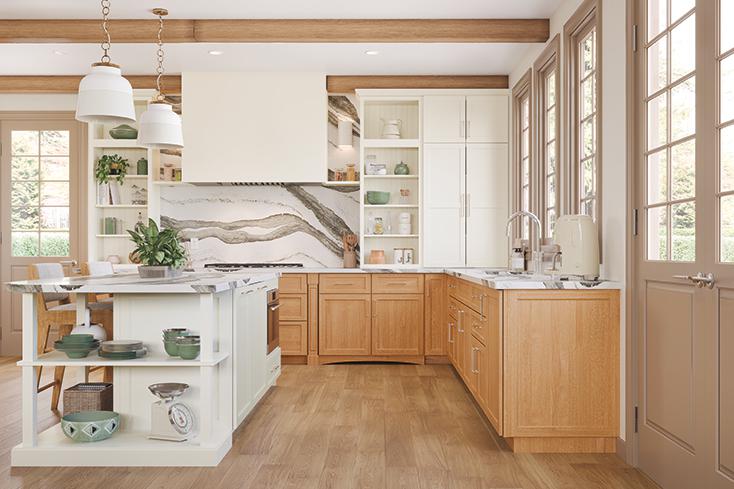
A well-placed kitchen island improves entertaining by creating a natural gathering point that pulls guests toward the kitchen instead of leaving the cook working alone. Islands with seating double as a casual spot for guests to sit, chat, and snack while food is being prepared, which takes pressure off formal dining space and keeps the host in the middle of the action rather than isolated. Islands also add valuable prep and serving surface area, which matters most exactly when you need it — during a party, not on an ordinary Tuesday.
Sizing and placement matter more than people expect here. An island that's too large for the room can actually restrict circulation and make entertaining harder, while one sized correctly for the space improves both flow and function. This is where working with an experienced kitchen design center pays off, since island proportions need to balance seating capacity against comfortable walking clearance on every side.
What storage features actually help when hosting?
The storage features that help most with entertaining are the ones that keep everyday clutter out of sight while making serving essentials easy to access. Custom kitchen cabinets built with entertaining in mind often include dedicated spaces for serving platters, extra glassware, and linens — items used occasionally but awkward to store in standard cabinet configurations. A pantry with pull-out shelving or a beverage station with built-in storage for drinks and bar tools can also dramatically reduce the chaos of party prep.
This is one of the clearest advantages of custom cabinetry over stock options. Rather than adapting your entertaining habits to fit standard cabinet sizes, custom cabinets can be designed around exactly what and how much you actually need to store for hosting, without sacrificing everyday functionality the rest of the year.
Does lighting really make a difference for entertaining spaces?
Lighting plays a bigger role in how a kitchen feels during entertaining than most homeowners expect, affecting both mood and functionality. Layered lighting — a combination of ambient, task, and accent lighting — allows a kitchen to shift from bright and functional during food prep to warmer and more relaxed once guests arrive. Under-cabinet lighting, pendant fixtures over an island, and dimmable overhead lighting all work together to give a kitchen the flexibility to transition smoothly from cooking mode to hosting mode.
Poor lighting, by contrast, can make even a beautifully designed kitchen feel harsh or uninviting once the sun goes down. It's a detail that's easy to overlook during a remodel but makes a noticeable difference in how comfortable a space feels once people are actually gathered in it.
How does indoor-outdoor flow factor into entertaining-focused kitchen design?
Indoor-outdoor flow matters significantly in Longmont, where much of the entertaining season happens with doors open to a patio or backyard. A kitchen positioned near sliding doors, a covered patio, or an outdoor kitchen setup lets hosting naturally extend beyond the kitchen's four walls, especially during Colorado's long stretch of good-weather months. Layout decisions like where prep and serving areas sit relative to exterior doors can make a real difference in how easily food and drinks move between indoor and outdoor gathering spaces.
This is worth discussing early in the design process, especially if outdoor entertaining is a priority for your household. A kitchen design center that considers your whole entertaining flow — not just the kitchen in isolation — will factor in these transitions from the start rather than treating them as an afterthought.
A Kitchen Designed for How You Actually Gather
The best entertaining kitchens aren't necessarily the biggest ones — they're the ones designed around how people actually move, gather, and interact once they're in the space. Thoughtful layout choices, the right island proportions, smart custom cabinetry, and layered lighting all work together to turn hosting from stressful into something that feels natural. The Designery Longmont designs kitchens with exactly this kind of real-life entertaining in mind, so the next time people gather in your home, the kitchen works exactly the way you need it to.