
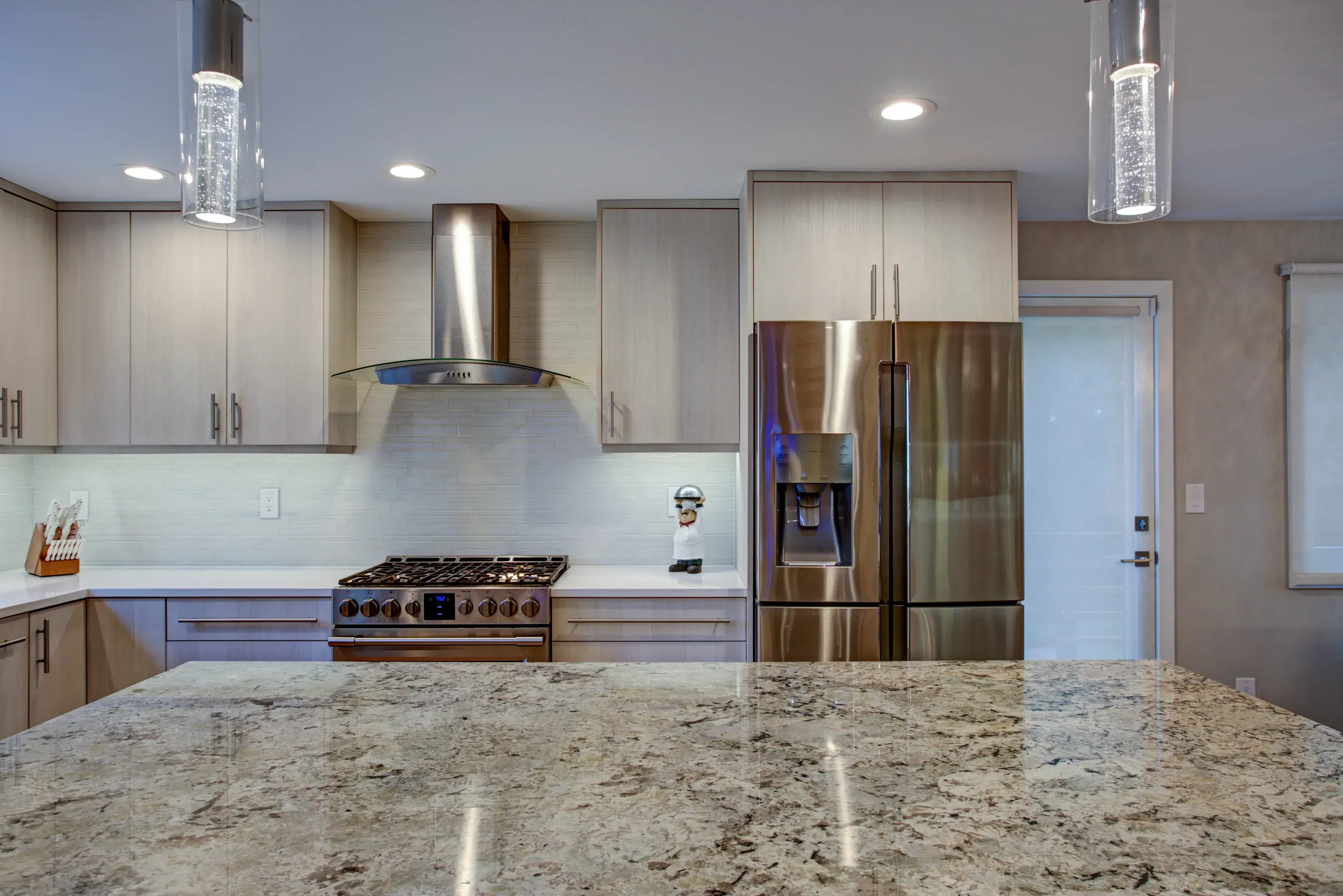
If you've been shopping for new countertops in Boulder County, you've probably landed on the same big question that nearly every homeowner asks: quartz or granite? Both are beautiful. Both are durable. And both will absolutely transform your kitchen or bathroom. But they're not the same, and the right choice really does depend on your lifestyle, your priorities, and how you use your space.
In the unique climate of the Front Range—where we deal with intense sub-alpine UV rays, rapid humidity shifts, and an active, outdoorsy lifestyle—your countertops need to do more than just look good. They need to perform. At The Designery Longmont, we help Boulder County homeowners navigate this decision every single day. Whether you are prepping a historic Mapleton Hill Victorian for resale or finishing a modern custom build in the foothills, understanding the "DNA" of your stone is the first step toward a successful remodel.
What is the Actual Structural Difference Between Natural and Engineered Stone?
To understand which "wins," you first have to understand what they actually are. Granite is a 100% natural igneous rock quarried directly from the earth in massive blocks. It is then sliced into slabs and polished. Every slab is one of a kind, with its own unique veining, color variation, and mineral patterns that took millions of years to form under the earth's crust.
Quartz, on the other hand, is an "engineered" stone. While it is composed of roughly 90% to 94% crushed natural quartz crystals (one of the hardest minerals on earth), those crystals are bound together with high-quality polymer resins and pigments.
Think of the difference like this: Granite is like a unique piece of driftwood found on a beach—completely natural and impossible to replicate. Quartz is like high-end glulam timber—engineered for specific strengths, consistency, and predictable performance. Neither is "fake" and neither is "cheap." They are simply different tools designed for different jobs.
Why Does Porosity Matter for Your Kitchen’s Hygiene? (The Maintenance Divider)
This is where quartz pulls ahead for a lot of busy Boulder families. Because quartz is engineered with resin, it is "non-porous." This means the surface is effectively sealed at a molecular level. Liquids, bacteria, and staining agents like red wine or coffee cannot seep into the material. You wipe it down with mild soap and water, and you are done. There is no sealing required, ever.
Granite is naturally porous. It contains microscopic "pores" that can draw in liquids if the surface isn't protected. This is why granite must be professionally sealed upon installation and then resealed roughly once a year.
The "Which Means for You" Reality:
● Quartz: You can leave a spill overnight without panic. It is a "set it and forget it" surface.
● Granite: You are a "steward" of a natural material. If you enjoy the ritual of caring for high-quality natural goods—like oiling a cutting board or conditioning leather—the annual sealing of granite is a small price to pay for its beauty. However, if you skip this step, granite becomes vulnerable to permanent staining from oils and acids.
How Do Colorado’s High-Altitude Elements Affect Stone Durability?
Living at 5,000+ feet puts unique stresses on interior materials. In Boulder, we experience "thermal shock"—rapid temperature swings—and intense UV exposure that can fade lower-quality materials over time.
The Heat Test Granite is virtually heat-proof. It was formed in volcanic heat, so it can handle a hot Dutch oven placed directly on the surface without flinching. Quartz, however, contains resin. Sustained, high-level heat can actually "scorch" or melt that resin, leaving a permanent yellow or brown ring. In a quartz kitchen, trivets and hot pads are non-negotiable.
The UV Factor Boulder gets over 300 days of sunshine a year. If your kitchen has large, south-facing windows, UV stability matters. Natural granite is extremely UV-stable; it won't fade or change color even in direct sun. Because quartz uses pigments and resins, some colors (especially darker tones) can experience a slight "ambering" or color shift if exposed to intense, direct sunlight over many years.
Can You Get a Truly Consistent Look with Natural Stone? (Aesthetics and Customization)
This is a matter of personal design philosophy. If your design vision calls for a "Modern Organic" look where the stone is the star of the show, granite delivers a level of depth and "movement" that human engineering struggles to match. The flecks of mica, the translucent quartz deposits, and the sweeping veins are art pieces in themselves.
If your vision is "Modern Minimalist" or "Scandi-Chic," quartz is usually the better fit. Because it is manufactured, quartz offers:
● Pattern Consistency: You can view a small sample and know exactly what the whole countertop will look like.
● Seam Invisibility: If you have a large L-shaped island, it is much easier to hide the seams with quartz because the pattern is predictable.
● Unique Colors: Quartz can be bright, clinical white or deep, matte concrete-grey—colors that are rare or non-existent in the natural granite world.
What is the Real-World Cost Comparison in Boulder County for 2026?
In 2026, the price gap between these two materials has narrowed significantly. In the Boulder and Longmont area, you can expect to pay between $60 and $150 per square foot installed for either material.
What actually drives the price?
-
Rarity: A common "Level 1" granite may actually be cheaper than a premium, name-brand quartz. Conversely, an "Exotic" granite from Brazil can cost triple what a standard quartz slab costs.
-
Complexity: Intricate edge profiles (like an Ogee edge) or complex cutouts for farmhouse sinks will add labor costs regardless of the material.
-
The "Hidden" Cost: With granite, you should factor in the cost of a high-quality sealer every 12–18 months. While you can do this yourself for about $30 in materials, some homeowners prefer a professional service, which can run $200–$400 per visit.
How Do You Choose Which Stone "Wins" for Your Lifestyle?
At The Designery Longmont, we tell our clients that there is no wrong choice—only a choice that doesn't fit your daily habits.
Choose Quartz if:
● You have young children who might leave juice spills or markers on the counter.
● You want a crisp, white, modern aesthetic.
● You want a low-maintenance home where you never have to think about "sealing" your stone.
Choose Granite if:
● You are a serious home chef who wants to take pans directly from the oven to the counter.
● You want a "one-of-a-kind" centerpiece that no one else in Boulder has.
● You have a sun-drenched kitchen with massive windows where UV fading is a concern.
Why Seeing the Full Slab is Non-Negotiable
A 4x4-inch sample is like looking at a single pixel of a photograph. It doesn't tell the whole story. This is especially true for granite, where a massive vein might appear in the middle of a slab that wasn't visible in the sample.
We invite you to visit our Longmont showroom—just a short drive from Boulder. We serve as the essential quality control layer for your project, managing the technical burdens of measurement and installation so you can focus on the design. We’ll help you walk through the rows of slabs, feel the textures, and see how the light hits each surface.
Allow us to handle the heavy lifting while you enjoy the transformation of your home.
Quartz vs Granite Frequently Asked Questions
1. Does quartz or granite add more resale value to a Boulder home?
In the current Boulder real estate market, both are considered "high-end" finishes. According to local design trends, quartz is currently slightly more popular for its modern look, but granite is still the gold standard for luxury "mountain-modern" homes in the foothills. Both will significantly increase your home’s appeal compared to laminate or tile.
2. Can I use granite or quartz for an outdoor kitchen in Colorado?
Granite is the clear winner for outdoor use. It can handle the freeze-thaw cycles of Colorado winters and the intense summer sun without fading or cracking. Quartz is generally not recommended for outdoor use because the resins can yellow and degrade under constant UV exposure.
3. Is quartz more "eco-friendly" than granite?
This is a complex balance. Granite is a natural resource that requires significant energy to quarry and transport. Quartz uses waste byproducts (crushed stone) but requires chemical resins for binding. If sustainability is your priority, look for "GREENGUARD" certified quartz or locally sourced stone options.
4. How do I tell if my granite needs to be resealed?
The "Water Test" is the easiest way. Pour a small puddle of water on your counter. If the water beads up, your sealer is still working. If the stone darkens or the water "soaks in" within 10 minutes, it’s time to reseal. Quartz will always pass the water test without help!